
Scrum simulator: what Scrumagic is and how a run works
By Scrumagic Team Last reviewed 5 min read
In short
Scrumagic is a Scrum training simulator. You take one role on a six-person team, such as Scrum Master, Product Owner or Developer, and AI teammates play the other five. You run a fictional project from the sponsor's first request to release, making the calls a real team would face, one step a day.
Reading about Scrum teaches you the words. Running a Sprint teaches you what to do when the words don't help: when the sponsor wants one more feature, the estimate looks wrong, or a blocker surfaces on day three. Most people have to wait for a job to find out how they handle that. Scrumagic is a way to practise before you get one.
What it is
Scrumagic is a Scrum simulator. You take one role on a six-person team, and named AI teammates play the other five. Together you run a complete fictional software project, from the sponsor's first request through the Sprints to release and closure. The process it follows is aligned with the SBOK® Guide, and the situations are written to feel like real work, with a budget, a deadline and people who disagree.
It is built for people who need the judgement more than the vocabulary: someone aiming to become a Scrum Master or Product Owner, an engineer new to Scrum who wants to see what each meeting is for, a learner on a course who wants something to apply it to, or a manager who wants a repeatable exercise for a team.
Picking a project and a role
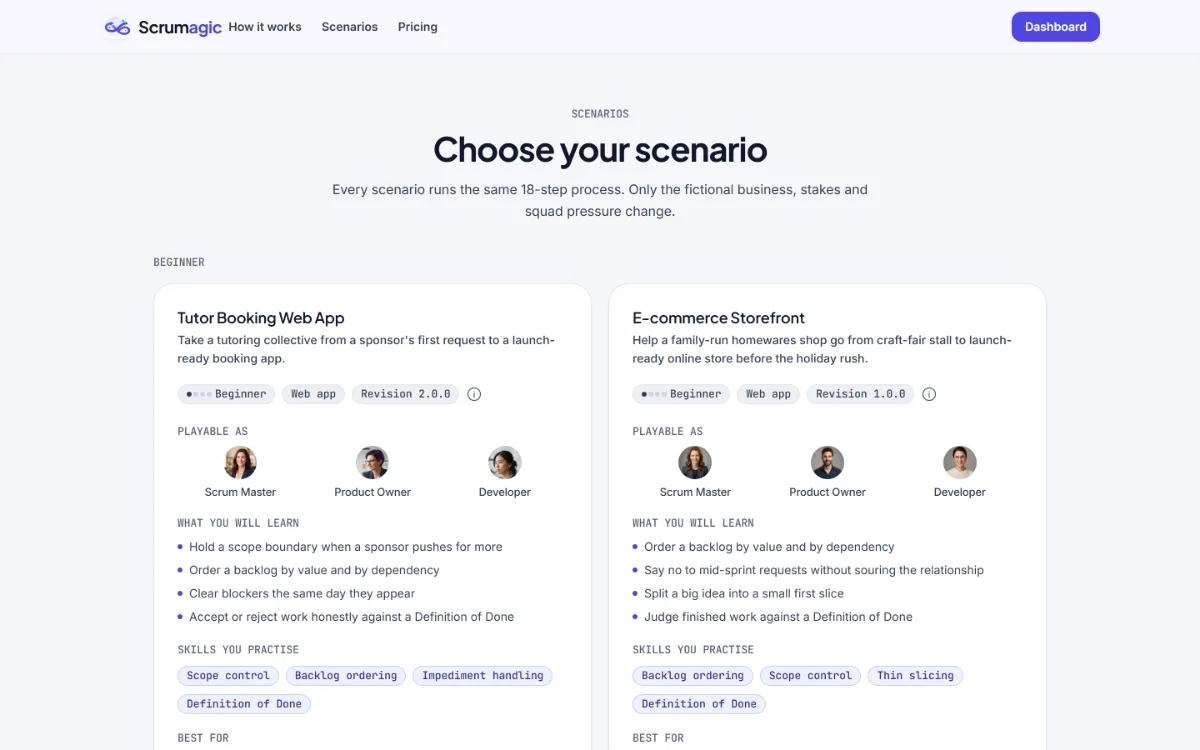
Every simulation starts with a scenario, which is a self-contained fictional business with its own budget, deadline, people and pressures. All of them follow the same process and differ in their content. The scenarios at a glance describes the set.
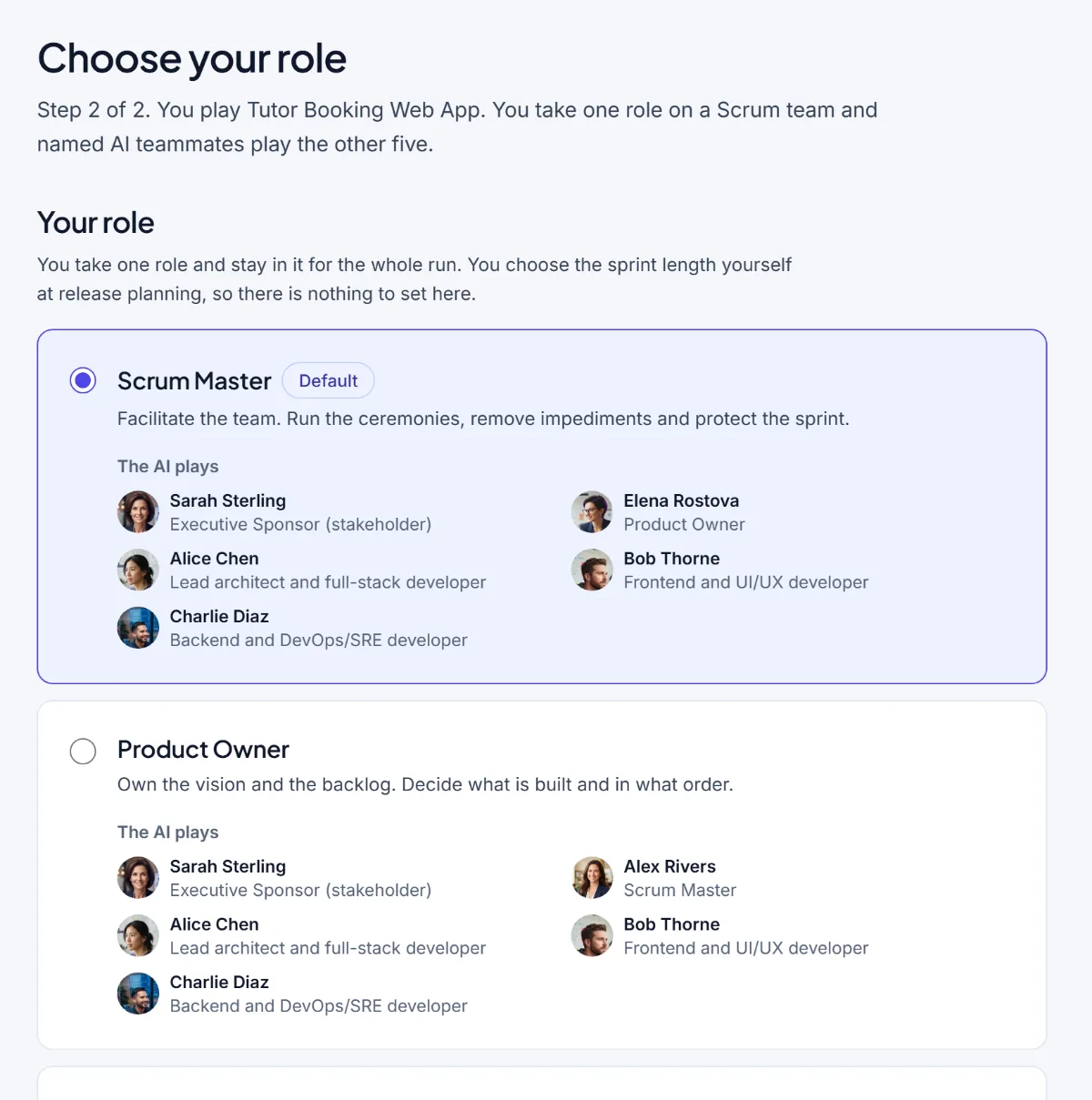
Then you choose your role. You can be the Scrum Master, the Product Owner or a Developer, and you stay in that role for the whole run. The other roles are played by the AI. The next post, choosing your role, explains what each one asks of you.
What a step looks like
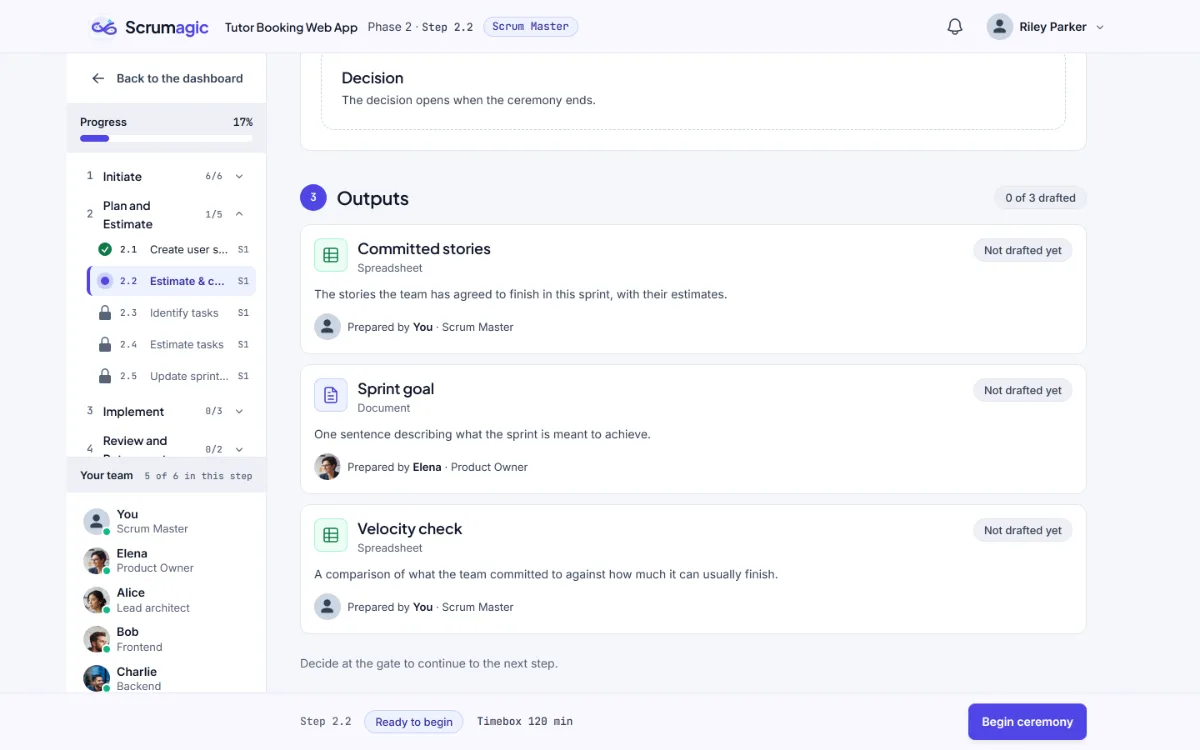
A run has five phases and eighteen steps. Every step follows the same pattern:
- Inputs. You read what the team has in front of it: a business case, a backlog, a velocity check, a draft of something.
- The ceremony. The team meets. Your AI teammates talk, disagree and push back, in character, and you take part. They remember what happened in earlier steps, so a decision you made in Phase 1 can come back in Phase 3.
- The decision gate. At the end you act as your role would: ratify something, choose between options, set a constraint. Some decisions can't be undone.
- Outputs. The step produces the artifacts a real team would have by now: a charter, a ranked backlog, committed stories, a sprint backlog.
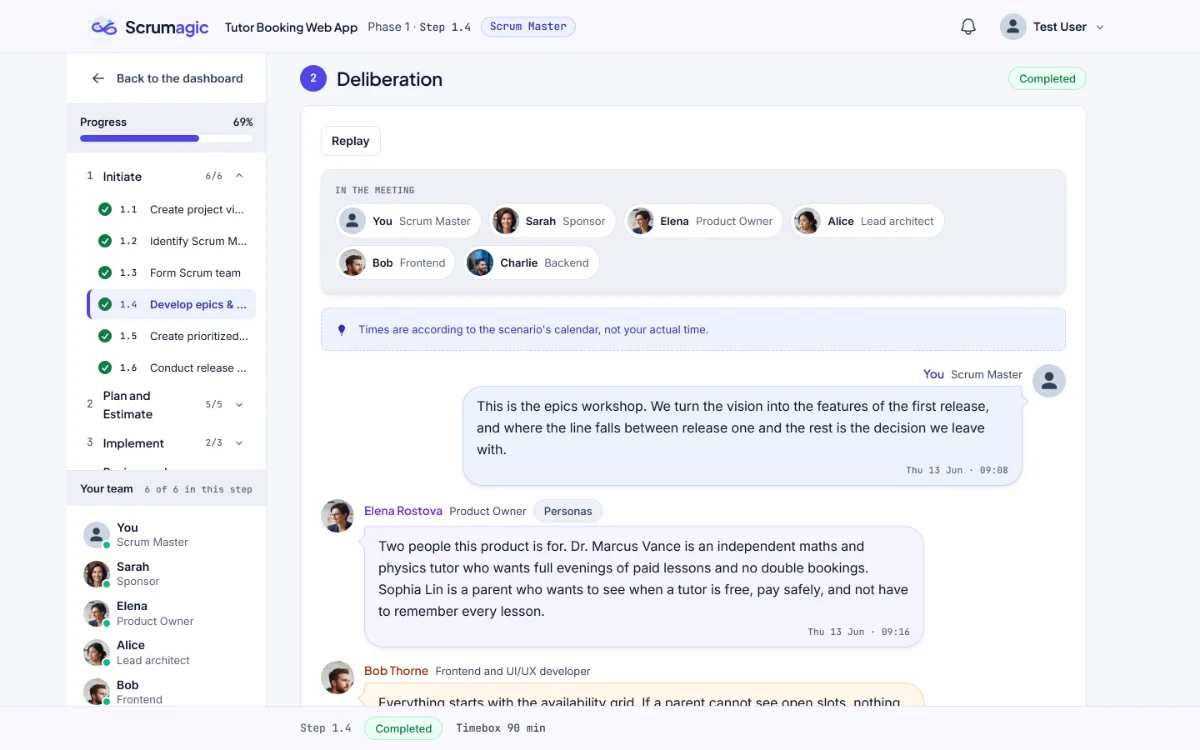
The outputs are not decoration. They are what the next step reads, so a rushed or careless decision shows up where you would expect it to.
The pace: one step a day
A step opens the day after the previous one, in your own time zone. That is deliberate. Real teams don't go from vision to release in an afternoon, and spacing the work gives you a night to think about a decision before you meet its consequences. It also means a full run is spread over many days, a little work at a time, and never one long sitting. The first phase, steps 1.1 to 1.6, is free to start. The pricing page says what the rest of a run needs.
What the AI teammates do and don't do
They play their roles in every ceremony, keep the same name and personality for the whole run, and talk to you the way that role would. The Product Owner protects the Sprint Goal. The developers argue about estimates. The sponsor cares about the date.
What they don't do is score you. The scorecard at the end follows fixed rules applied to the decisions you recorded: budget adherence, estimation accuracy, business value delivered, and how well you followed Scrum. It isn't produced by an opinion of your chat messages. And it is a scorecard, not a certificate. Nothing in Scrumagic is a qualification, and it doesn't claim to prepare you for any particular exam.
It's also worth being straight about the limit of the format: a simulated team is more predictable than a real one. The aim isn't to replace the experience of working with people. It is to let you make a lot of consequential mistakes, early, without anyone paying for them.
Why it fits the way software is built now
More and more code is produced with the help of AI tools, which shifts where the hard part of delivery sits: less in typing, more in deciding what to build, what counts as finished, and how to react when feedback arrives. Those are exactly the calls a run puts in front of you. Scrumagic doesn't teach you to use AI coding tools, and it doesn't claim to. What it exercises is the judgement that decides whether the work was worth doing.
Where to start
If you're new to Scrum, read what Scrum is first, then try a run as the Scrum Master. If you are still comparing options, what a Scrum simulator is sorts the kinds out, and the free Scrum simulator post says what Phase 1 includes. If you already know the framework, the posts on Sprint Planning and the Definition of Done will tell you what to watch for in steps 2.2 and 1.5.
SBOK® is a registered trademark of its owner. Scrumagic is independent and is not affiliated with the owners of SBOK®.
Nothing opened? This computer may have no email program set up. Write it in Gmail or use the copy button and paste the link into your email.